
One of the fundamental pillars in the fight against viruses, diseases and environmental challenges is the immune system (IS). Proper regulation of the IS manifests itself in a highly effective and localized organic response to environmental perturbations. Among the most studied immune responses, especially in the context of autoimmune and neurodegenerative diseases, is inflammation. Analogous to the inflammation we experience locally in response to physical injury, the body as a whole, and in particular the nervous system, reacts to stimuli that threaten its equilibrium by means of an immune response.
However, while a perfect immune response would eliminate the occurrence of disease, it is clear that this ideal does not materialize. For example, an insufficient immune response is ineffective in protecting us, while an overly aggressive response can cause irreparable damage to the body and organs.
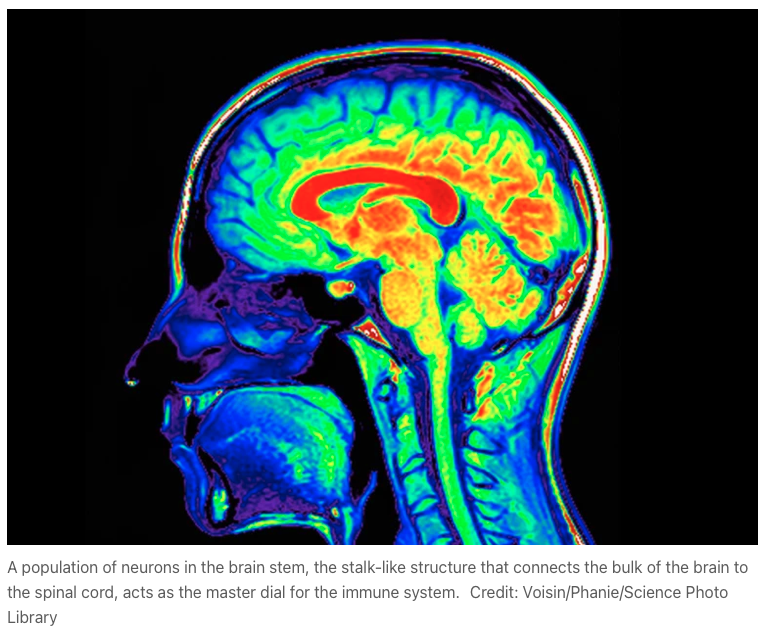
Against this background of the importance of IS, the study recently published in the NATURE portal is relevant. The team led by Dr. Hao Jin has identified the neuronal response to bacterial attack that triggers inflammation, specifically in neurons located in the brainstem (check the article here: https://www.nature.com/articles/d41586-024-01259-2). The remarkable contribution of this finding lies in the discovery of the mechanism of action of these neurons, so specific that, by inhibiting their activity, a 300% increase in the inflammatory response was observed. In other words, this neuronal ensemble has the capacity to modulate the response of the IS to perturbing stimuli, and this level of specificity, as evidenced in the study, can be manipulated by means of experimental procedures in animal models, such as mice.
Now, as I usually mention, it will not be strange to read, see or hear news that populistically deliver the results of the present work. That is why we must be cautious, and although it is a very important advance in the fight against diseases such as Multiple Sclerosis, which is characterized by failures in the IS, a lot of work is still needed for direct application in patients.
Se Descubre Mecanismo Clave del Sistema Inmunológico
Uno de los pilares fundamentales en la lucha contra virus, enfermedades y los desafíos ambientales es el sistema inmunológico (SI). La adecuada regulación del SI se manifiesta en una respuesta orgánica altamente efectiva y localizada frente a las alteraciones ambientales. Entre las respuestas inmunológicas más estudiadas, especialmente en el contexto de enfermedades autoinmunes y neurodegenerativas, se encuentra la inflamación. Analogamente a la inflamación que experimentamos localmente en respuesta a una lesión física, el cuerpo en su totalidad, y en particular el sistema nervioso, reacciona a estímulos que amenazan su equilibrio mediante una respuesta inmunológica.
No obstante, si bien una respuesta inmunológica perfecta eliminaría la aparición de enfermedades, es evidente que este ideal no se materializa. Por ejemplo, una respuesta inmunológica insuficiente resulta ineficaz para protegernos, mientras que una respuesta excesivamente agresiva puede ocasionar daños irreparables en el cuerpo y los órganos.
Con este trasfondo sobre la importancia del SI, resulta relevante el estudio recientemente publicado en el portal NATURE. El equipo dirigido por el Dr. Hao Jin ha identificado la respuesta neuronal ante el ataque bacteriano que desencadena inflamación, específicamente en las neuronas ubicadas en el tronco encefálico (lee el articulo aquí: https://www.nature.com/articles/d41586-024-01259-2). La notable contribución de este hallazgo radica en el descubrimiento del mecanismo de acción de estas neuronas, tan específico que, al inhibir su actividad, se observó un aumento del 300% en la respuesta inflamatoria. En otras palabras, este conjunto neuronal tiene la capacidad de modular la respuesta del SI frente a estímulos perturbadores, y este nivel de especificidad, tal como se ha evidenciado en el estudio, puede ser manipulado mediante procedimientos experimentales en modelos animales, como ratones.
Ahora bien, y como suelo mencionar, no será extraño leer, ver o escuchar noticias que entreguen de manera populista los resultados del presente trabajo. Es por ello que debemos ser cautelosos, y si bien, es un avance muy importante para la lucha de enfermedades como la Esclerosis Multiple, la cual se caracteriza por fallas en el SI, aun es necesario mucho trabajo para la aplicación directa en pacientes.


